Mapping Media Freedom records 626 violations in 2021
[vc_row][vc_column width="2/3"][vc_single_image image="5941" img_size="medium"][vc_column_text]Partners of the Media Freedom Rapid Response (MFRR) have published the latest MFRR Monitoring Report, outlining the state of media freedom throughout all EU member states, candidate countries, and the United Kingdom in 2021.
The report includes a visual analysis of the data compiled for Mapping Media Freedom, which collects and visualises all press freedom violations recorded by the MFRR monitoring partners. Before delving into country-specific analyses, the report highlights media freedom violations linked to COVID-19 and online/digital attacks, two categories that feature prominently throughout the 2021 report. The report closes with a list of positive developments for media freedom in the previous year.
An overview of the report’s key findings can be found below.[/vc_column_text][vc_btn title="Read the full report here `{`ENG`}`" color="sky" align="center" i_icon_fontawesome="fa fa-file-pdf-o" add_icon="true" link="url:https%3A%2F%2Fwww.ecpmf.eu%2Fwp-content%2Fuploads%2F2022%2F02%2FMFRR-Monitoring-Report.pdf||target:%20_blank|"][vc_separator][vc_column_text]From January to December 2021, 626 alerts were documented on Mapping Media Freedom (MapMF), ranging from verbal attacks to legal incidents. These alerts affected 1,063 individuals or media entities in 30 countries. The violations include the murders of three journalists: investigative journalist Peter R. de Vries in the Netherlands, veteran crime reporter Giorgos Karaivaz in Greece, and local radio presenter Hazım Özsu in Turkey.[/vc_column_text][vc_single_image image="7935" img_size="full"][vc_column_text]
The most commonly recorded type of violation was verbal attacks (41.1%), which includes intimidation, harassment, and insults. This is followed by legal incidents (25.4%), physical attacks (21.1%), and censorship (11.3%) such as arbitrary denial of accreditation or registration.
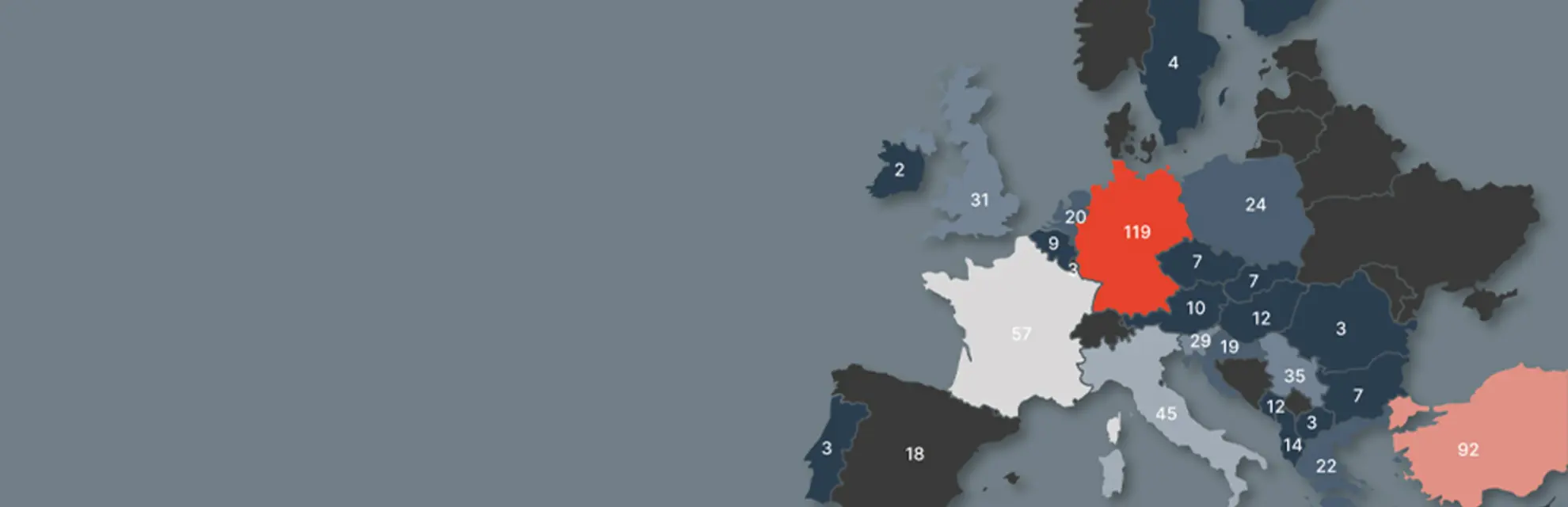
[/vc_column_text][vc_single_image image="7938" img_size="full"][vc_column_text]The 2021 Monitoring Report — much like 2020 — was marked by the impacts of the COVID-19 pandemic and the associated restrictions. In fact, more than one quarter (26.5%, 166 violations) of all alerts logged on MapMF in 2021 were linked to the pandemic. These involved attacks on 252 different persons or entities in 19 countries. Many of these alerts involved physical and online attacks on journalists reporting on anti-vaccine and anti-lockdown protests.[/vc_column_text][vc_single_image image="7940" img_size="full"][vc_column_text]In terms of where the attacks took place, most media freedom violations took place at demonstrations, where 178 alerts were recorded — 28.4% of the total. Following this, alerts were also recorded online or in digital spheres (16.8%), in public places or on the street (13.1%), at court (11.2%), at work (7.2%), during an event (4.3%), at press conferences (2.9%), and at police stations (2.9%). A breakdown of other contexts for violations can be found below.[/vc_column_text][vc_single_image image="7942" img_size="full"][vc_column_text]As was the case in previous reports, private individuals remain the main perpetrators of attacks, with 41.2% of all violations. This is followed by police or state security (18.5%), legislation i.e. government/public officials (12.3%), unknown sources (10.7%), and the judiciary i.e. from a court (7.2%). A full break down of all other sources of violations can be found in the infographic below.[/vc_column_text][vc_single_image image="7944" img_size="full"][vc_column_text]The report continues to outline the media freedom situation in Germany (119 alerts), Turkey (92), France (57), Italy (45), Serbia (35), Slovenia (29), Poland (24), Greece (22), the Netherlands (20), Spain (18), Albania (14), Montenegro (12), and Hungary (12).
Once again, the MapMF Monitoring Report has highlighted that the media is a target for many actors, ranging from governments trying to obstruct free press to individuals who are unhappy with the current social, health, and economic situation. Despite this, the past year has shown as clearly as ever how vital the work of independent media is. During crises and turmoil, as evidenced by the ongoing COVID-19 pandemic, it is essential that journalists can work freely and safely to ensure they can offer information to the public when it is most needed.[/vc_column_text][vc_btn title="Read the full report here `{`ENG`}`" color="sky" align="center" i_icon_fontawesome="fa fa-file-pdf-o" add_icon="true" link="url:https%3A%2F%2Fwww.ecpmf.eu%2Fwp-content%2Fuploads%2F2022%2F02%2FMFRR-Monitoring-Report.pdf||target:%20_blank|"][nd_options_image nd_options_image="5871" nd_options_width="100%"][vc_cta h2=""]This Monitoring Report is part of the Media Freedom Rapid Response (MFRR), an Europe-wide mechanism, which tracks, monitors and responds to violations of press and media freedom in EU Member States and Candidate Countries. This project provides legal and practical support, public advocacy and information to protect journalists and media workers. The MFRR is organised by an consortium led by the European Centre for Press and Media Freedom (ECPMF) with ARTICLE 19, the European Federation of Journalists (EFJ), Free Press Unlimited (FPU), the Institute for Applied Informatics at the University of Leipzig (InfAI), International Press Institute (IPI) and CCI/Osservatorio Balcani e Caucaso Transeuropa (OBCT). The project is co-funded by the European Commission. www.mfrr.eu[/vc_cta][/vc_column][vc_column width="1/3"][vc_widget_sidebar sidebar_id="nicdark_sidebar"][/vc_column][/vc_row][vc_row][vc_column][vc_text_separator title="Related news" title_align="separator_align_left" color="sky"][nd_options_post_grid nd_options_layout="layout-9" nd_options_width="nd_options_width_33_percentage nd_options_float_left" nd_options_orderby="date" nd_options_qnt="6"][/vc_column][/vc_row]